Why Does Every AI Claim to Be a Genius — But Feel So Different in Practice?
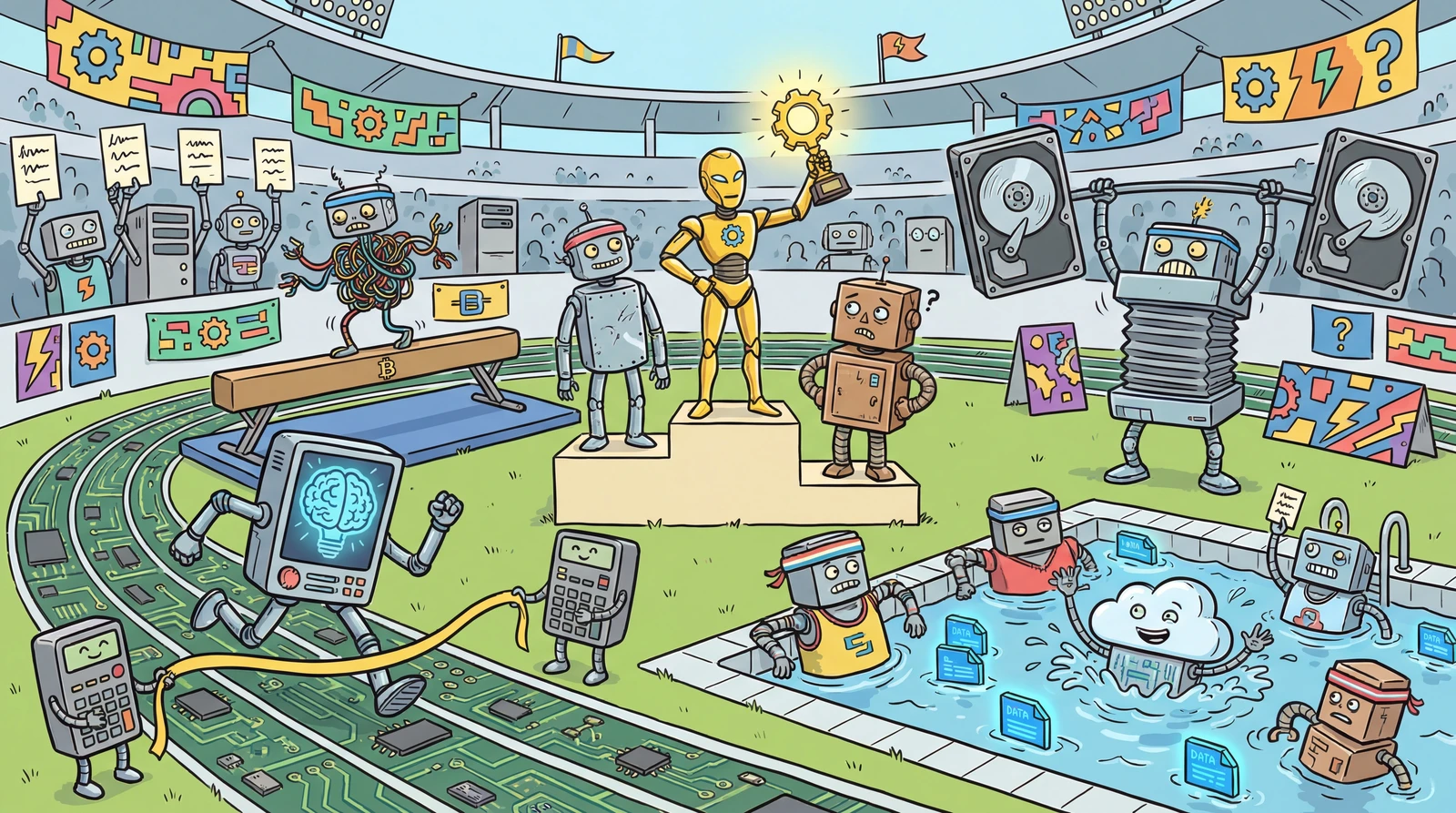
“Passed the bar exam in the top 10%.” “Smarter than a PhD.” Lately, every new AI model launch sounds like a breakthrough.
But when you actually use them? Some AI gets exactly what you mean, while others confidently spit out nonsense.
The benchmark scores are all bunched up in the 90s — so why does the real-world experience feel so different?
Here’s a plain-language breakdown of how AI performance is measured, what benchmarks actually test, and how much you should really trust them. Five minutes, no PhD required.
listContentsexpand_more
- 1. How Do We Actually Measure AI Performance?
- 2. What Kinds of Benchmarks Are There?
- 3. Key Benchmarks and Their TOP 5
- ① MMLU / MMLU-Pro — “The AI Entrance Exam”
- ② GPQA Diamond — “The AI Graduate Exam”
- ③ HumanEval — “The AI Coding Test”
- ④ LiveCodeBench — “The Living Coding Test”
- ⑤ AIME 2025 — “The AI Math Olympiad”
- ⑥ SWE-bench Verified — “The AI Engineering Test”
- ⑦ Arena — “The AI Popularity Contest”
- ⑧ Humanity’s Last Exam (HLE) — “The Ultimate Human Test”
- ⑨ ARC-AGI-2 — “The General Intelligence Test”
- 4. The Limits of Benchmarks: Score ≠ Real-World Feel
- ① A test is just a test
- ② The contamination problem
- ③ A genius in one area ≠ a genius in all areas
- ④ Speed and cost matter too
- ⑤ “Good conversation” is hard to score
- 5. So, How Should You Actually Choose an AI?
1. How Do We Actually Measure AI Performance?
When you shop for a new smartphone, you compare specs — camera resolution, battery life, processing speed. Measuring AI is no different: you need a standardized benchmark to objectively answer “how smart is it?”
That’s exactly what a benchmark is — a standardized test for AI.
Every time a company releases a new model, they publish benchmark scores to back up the hype. These scores typically come from three things:
-
Test questions — the prompts or tasks given to the AI
-
Scoring method — objective criteria like accuracy rates or whether code actually runs
-
Leaderboard — how the model stacks up against the competition
Just like TOEIC measures English proficiency, AI benchmarks measure specific AI capabilities.
That’s why there are many different kinds — knowledge, coding, math, conversation — and no single benchmark captures everything an AI can do.
2. What Kinds of Benchmarks Are There?
AI benchmarks fall into six broad categories.
| Category | What It Measures | Human Analogy |
|---|---|---|
| 🧠 General Knowledge | Breadth of knowledge across many fields | A comprehensive college entrance exam |
| 💻 Coding | Ability to solve programming challenges | A technical coding test |
| 🛠️ Real-World Software | Fixing bugs in actual codebases | A hands-on engineering skills test |
| 🔬 Expert Reasoning | PhD-level science and medicine problems | A graduate qualifying exam |
| 🔢 Math | Competition-level math problems | A math olympiad |
| 💬 Conversation Quality | Human-rated satisfaction with AI responses | A subjective panel interview |
3. Key Benchmarks and Their TOP 5
① MMLU / MMLU-Pro — “The AI Entrance Exam”
Massive Multitask Language Understanding.
A multiple-choice test spanning 57 subjects (history, physics, law, medicine, and more).
-
Think of it as taking every subject on a national college entrance exam at once
-
MMLU-Pro is the upgraded version — more answer choices, harder questions, less room for lucky guesses
-
⚠️ Most top AI models now score above 90%, making it hard to tell them apart
TOP 5 (as of March 2026)
https://onyx.app/llm-leaderboard
| Rank | AI Model | Score |
|---|---|---|
| 🥇 1st | Moonshot / Kimi K2.5 | 92.0% |
| 🥈 2nd | Google / Gemini 3.1 Pro | 91.8% |
| 🥉 3rd | Anthropic / Claude Opus 4.6 | 91.0% |
| 4th | DeepSeek / DeepSeek R1 | 90.8% |
| 5th | OpenAI / GPT-oss 120B | 90.0% |
② GPQA Diamond — “The AI Graduate Exam”
Graduate-Level Google-Proof Q&A. PhD-level questions in physics, chemistry, and biology.
-
Think of it as a doctoral qualifying exam
-
True to the “Google-Proof” name — you can’t just look up the answers
-
Even domain experts average only around 65%
TOP 5 (as of March 2026)
https://epoch.ai/benchmarks/gpqa-diamond
| Rank | AI Model | Score |
|---|---|---|
| 🥇 1st | OpenAI / GPT-5.4 Pro | 94.6% |
| 🥈 2nd | Google / Gemini 3.1 Pro | 94.1% |
| 🥉 3rd | Google / Gemini 3 Pro | 92.6% |
| 4th | OpenAI / GPT-5.2 | 91.4% |
| 5th | Anthropic / Claude Opus 4.6 | 90.5% |
③ HumanEval — “The AI Coding Test”
A programming test where AI writes Python functions. Given a description, write code that actually works.
-
Think of it as a technical coding screen for software engineers
-
164 problems; the code must run and pass unit tests
-
⚠️ Most top models now exceed 95%, making differentiation difficult — which is why LiveCodeBench was created
TOP 5 (as of March 2026)
https://pricepertoken.com/leaderboards/benchmark/humaneval
| Rank | AI Model | Score |
|---|---|---|
| 🥇 1st | Anthropic / Claude Sonnet 4.5 | 97.6% |
| 🥈 2nd | DeepSeek / DeepSeek R1 | 97.4% |
| 🥉 3rd | xAI / Grok 4 | 97.0% |
| 🥉 3rd | Google / Gemini 3 Pro | 97.0% |
| 🥉 3rd | Anthropic / Claude Sonnet 4.5 | 97.0% |
④ LiveCodeBench — “The Living Coding Test”
New problems added every month. Prevents AI from gaming the test by memorizing past questions.
-
Think of it as a coding contest with fresh problems every month
-
Built to address HumanEval’s weakness (problem leakage and rote memorization)
-
As of 2026, even the best models sit around 80%, so it still separates the pack
TOP 5 (as of March 2026)
https://benchlm.ai/benchmarks/liveCodeBench
| Rank | AI Model | Score |
|---|---|---|
| 🥇 1st | Moonshot AI / Kimi K2.5 | 85% |
| 🥈 2nd | Zhipu AI / GLM-4.7 | 84.9% |
| 🥉 3rd | OpenAI / GPT 5.4 | 84% |
| 4th | Xiamo / MiMo-V2-Flash | 80.6% |
| 5th | xAI / Grok Code Fast 1 | 80% |
NOTE
Same category, wildly different results — why?
LiveCodeBench tests mathematical logic and algorithms, while SWE-bench tests real-world bug fixing. Claude tops SWE-bench but falls behind on algorithmic problems. What “good at coding” means depends entirely on which benchmark you’re looking at.
⑤ AIME 2025 — “The AI Math Olympiad”
American Invitational Mathematics Examination. AI takes on elite math competition problems.
-
Think of it as a competition that only math prodigies qualify for
-
Problems require multi-step logical reasoning, not just calculation
-
Some top models have recently started hitting perfect scores, pushing the need for harder tests
TOP 5 (as of March 2026)
https://vellum.ai/llm-leaderboard
| Rank | AI Model | Score |
|---|---|---|
| 🥇 1st | Google / Gemini 3 Pro | 100% |
| 🥇 1st | OpenAI / GPT 5.2 | 100% |
| 🥉 3rd | Anthropic / Claude Opus 4.6 | 99.8% |
| 4th | Moonshot AI / Kimi K2.5 | 99.1% |
| 5th | OpenAI / GPT-oss 20B | 98.7% |
⑥ SWE-bench Verified — “The AI Engineering Test”
Fixing bugs in real open-source GitHub projects.
-
Think of it as an engineer actually digging into a massive real-world codebase to track down and fix bugs
-
The key difference from HumanEval: HumanEval asks you to write one small function; SWE-bench puts you inside a giant real project
-
Tests not just coding ability, but the capacity to understand context across a large codebase
TOP 5 (as of March 2026)
https://www.swebench.com/
| Rank | AI Model | Score |
|---|---|---|
| 🥇 1st | Anthropic / Claude Opus 4.5 | 76.8% |
| 🥈 2nd | Google / Gemini 3 Flash | 75.8% |
| 🥈 2nd | MiniMax / MiniMax M2.5 | 75.8% |
| 4th | Anthropic / Claude Opus 4.6 | 75.6% |
| 5th | OpenAI / GPT 5.2 Codex | 72.8% |
⑦ Arena — “The AI Popularity Contest”
People compare two AI responses side by side and vote for the one they prefer — without knowing which model is which.
-
Think of it as a blind panel interview where judges rate answers subjectively
-
Uses an Elo rating system (like chess rankings) — higher is better
-
Unlike other benchmarks, it directly reflects how real users feel about the experience
-
The downside: “sounding good” can win votes over “being right”
TOP 5 (as of March 2026 / Text-to-text tasks)
https://arena.ai/leaderboard/text
| Rank | AI Model | Elo Score |
|---|---|---|
| 🥇 1st | Anthropic / Claude Opus 4.6 | 1504 |
| 🥈 2nd | Google / Gemini 3.1 Pro | 1493 |
| 🥉 3rd | xAI / Grok 4.2 Beta 1 | 1491 |
| 4th | Google / Gemini 3 Pro | 1486 |
| 5th | OpenAI / GPT-5.4 High | 1484 |
⑧ Humanity’s Last Exam (HLE) — “The Ultimate Human Test”
2,500 brutally hard questions written by thousands of global experts who thought, “AI will never get this.”
-
Think of it as a final dissertation defense designed by Nobel Prize-level specialists
-
Covers the hardest problems in math, humanities, and science
-
As of March 2026, even the best models hover around 50% — still uncharted territory for AI
-
Functions as a gauge for how fast AI is actually advancing
TOP 5 (as of March 2026)
https://artificialanalysis.ai/evaluations/humanitys-last-exam
| Rank | AI Model | Score |
|---|---|---|
| 🥇 1st | Google / Gemini 3.1 Pro | 44.7% |
| 🥈 2nd | OpenAI / GPT 5.4 xHigh | 41.6% |
| 🥉 3rd | Anthropic / Claude Opus 4.6 | 36.7% |
| 4th | Google / Gemini 3 Flash | 34.7% |
| 5th | Anthropic / Claude Sonnet 4.6 | 30.0% |
⑨ ARC-AGI-2 — “The General Intelligence Test”
Measures the ability to spot patterns without any prior knowledge and apply them to new problems.
-
Think of it as the shape-reasoning section of an IQ test
-
Standard AI chatbots (LLMs) score near 0% — one of the toughest benchmarks in existence
-
The best AI so far (Gemini 3 Deep Think) has reached 84.6%, but at ~$13/task — extremely expensive
-
The closest thing we have to testing “real intelligence”
TOP 5 (as of March 2026)
https://arcprize.org/leaderboard
| Rank | AI Model (Cost per task) | Score |
|---|---|---|
| 🥇 1st | Google / Gemini 3 Deep Think ($13.62) | 84.6% |
| 🥈 2nd | OpenAI / GPT 5.4 Pro xHigh ($16.41) | 83.3% |
| 🥉 3rd | Google / Gemini 3.1 Pro ($0.962) | 77.1% |
| 4th | OpenAI / GPT 5.4 xHigh ($1.52) | 74.0% |
| 5th | Anthropic / Claude Opus 4.6 High ($3.47) | 69.2% |
4. The Limits of Benchmarks: Score ≠ Real-World Feel
A high benchmark score doesn’t guarantee a better AI for your actual use.
Benchmarks are useful reference points, but they come with real limitations.
① A test is just a test
Getting a perfect score on an exam doesn’t make you great at your job. The same goes for AI. A model that aces benchmarks might still give you useless answers in practice. Test score ≠ real-world usefulness.
② The contamination problem
Some AI models may have trained on data that included benchmark questions.
It's the equivalent of a student who had access to the actual exam questions beforehand. In AI, this is called “data contamination.”
③ A genius in one area ≠ a genius in all areas
The top math benchmark model isn’t necessarily the best writer.
Different AI models excel in different areas. The right AI for you depends on what you’re actually doing.
④ Speed and cost matter too
Even the smartest AI is hard to use daily if it takes 30 seconds to respond or costs a fortune per query.
Benchmarks typically measure intelligence only — speed, cost, and usability aren’t factored in.
⑤ “Good conversation” is hard to score
“This AI just gets me.” “The replies feel natural.” “It matches my style.” These kinds of subjective satisfaction are nearly impossible to capture with an objective test.
5. So, How Should You Actually Choose an AI?
Use benchmarks as a first filter to narrow down your options, then pick based on hands-on experience with your actual use case.
-
Define your use case first — coding? writing? studying? workflow automation?
-
Use the relevant benchmark to shortlist 2–3 candidates
-
Give them the same question and compare — your own hands-on experience is the most honest benchmark